
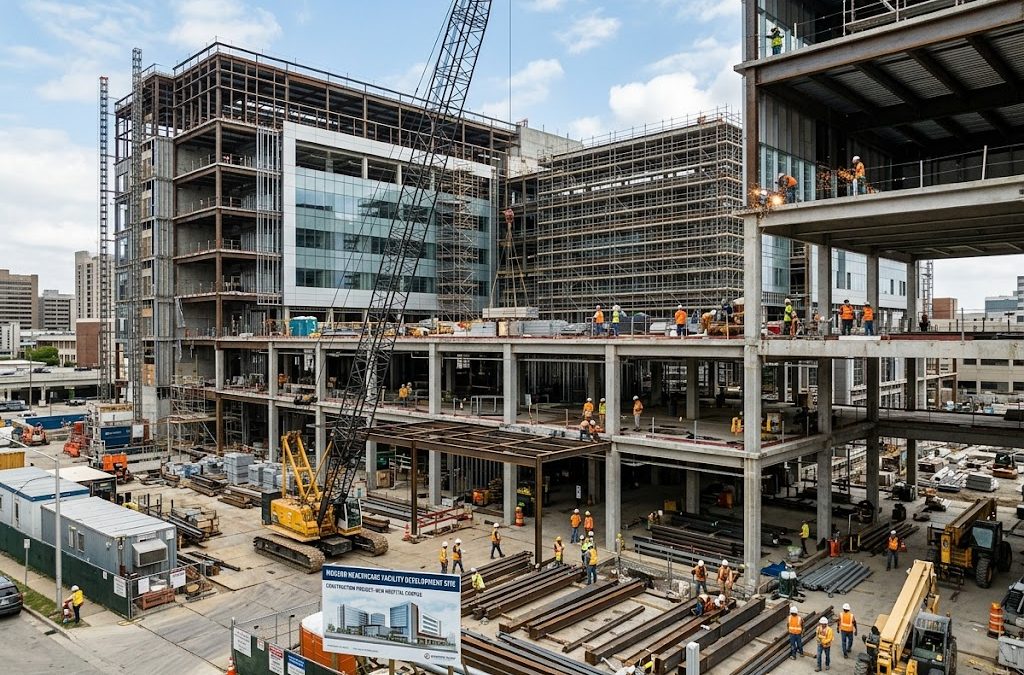
Constructing a healthcare facility is vastly different from building commercial office spaces or residential high-rises. Hospitals and medical centers are highly complex, active environments where engineering decisions directly impact human health, patient safety, and clinical outcomes. Managing these projects requires specialized multidisciplinary expertise and execution leadership.
When executing complex healthcare infrastructure projects, project managers and developers must keep several vital considerations at the forefront of their planning:
1. Infection Control Risk Assessment (ICRA)
Patient safety begins long before the first doctor walks through the door. During both greenfield construction and hospital expansions, adherence to strict ICRA protocols is mandatory. Dust, airborne pathogens (such as Aspergillus spores), and construction contaminants can be fatal to immunocompromised patients. Effective containment barriers, negative pressure zones, and advanced HEPA filtration systems must be integrated into the construction execution plan.
2. Specialized HVAC and Ventilation Systems
Healthcare facilities rely heavily on complex mechanical systems to isolate diseases and maintain sterile environments. Operating rooms, isolation wards, and intensive care units require precise pressure differentials, exact humidity controls, and high air-exchange rates. Engineers and procurement teams must ensure that these systems comply with rigorous national healthcare building codes and offer seamless automated control.
3. Redundancy and Life-Safety Systems
In a medical environment, power failure is not an option. Healthcare facility construction demands robust electrical and mechanical redundancy. This includes emergency backup generators, Uninterruptible Power Supplies (UPS) for critical life-support equipment, and isolated medical gas delivery piping (oxygen, vacuum, nitrous oxide) that undergo meticulous multi-stage testing and certification.
4. Future-Proofing and Structural Flexibility
Medical technology evolves rapidly. Successful healthcare construction considers the long-term lifecycle of the asset. Incorporating modular wall systems, generous interstitial spaces for future utility routing, and scalable structural loading capacities ensures that the facility can adapt to future technological advancements without requiring a complete structural overhaul.
At Canshine Group, we treat our clients as long-term partners. We combine integrated technical solutions and transparent management to navigate the highly regulated, multi-layered complexities of modern healthcare infrastructure.